With over 30 years of volume use and over 25 years of independent field test data, Polesaver Rot-Guard barrier sleeves offer a proven and highly cost-effective way to maximise pole life. In this article, we explore the effects of moisture, fungi and termites on sleeved and un-sleeved test samples and poles. These independent test results demonstrate the clear benefits of Polesaver's Rot-Guard product when used in conjunction with existing wood preservatives.
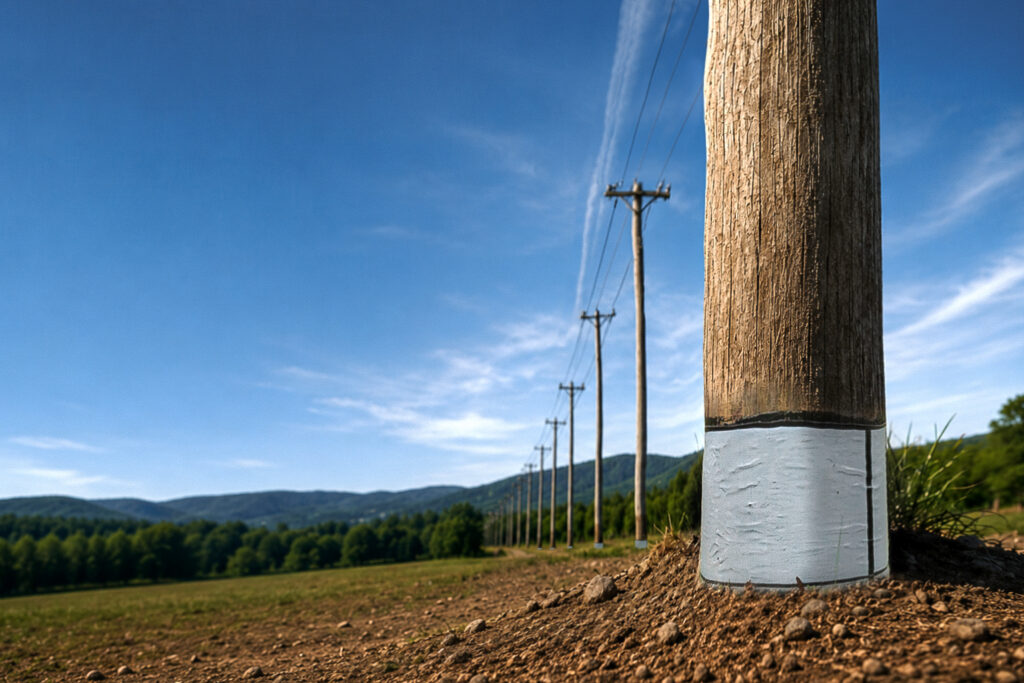
All of the factors necessary for wood decay are present in the upper 20cm (8″) of the ground. This section is the most common point of failure for utility poles and is also the most mechanically stressed. To prevent decay, moisture and wood-decaying organisms must be kept out and wood preservative must be retained. The Rot-Guard total barrier sleeve creates an air and watertight seal to achieve this. This unique dual barrier technology has the potential to significantly reduce remediation costs and improve grid hardening, reliability and safety.
The evidence of Polesaver's success is documented in independent test data and standards with no reported failures to date. Rot-Guard sleeves comply with:
Pole moisture content is a catalyst for decay, over time wetting and drying cycles can result in leaching and the subsequent reduction in the concentration of wood preservatives, leaving wood vulnerable to decay. If the moisture level of the timber is higher than 25%, the potential for decay increases which is a precursor to pole failure. During an Accelerated decay test (ENV807), a Rot-Guard protected sample showed less than 25% moisture content at the critical ground-line level after 48 weeks. In direct comparison, an unprotected sample showed levels of saturation higher than 150% in the same area. As decay set in, the respective samples experienced weight loss due to decay. The Rot-Guard protected sample showed no deterioration in the sleeved zone and no weight loss.
In contrast, the unprotected timber showed between 30-40% weight loss at the critical ground-line level. Furthermore, an independent 20-year field test (EN252) using Scots pine sapwood stakes showed that some unprotected samples failed after just eight years. In contrast, all of the Rot-Guard protected stakes showed no signs of decay after 20 years. Thanks to its air and watertight seal, the Polesaver Rot-Guard total barrier protection system excludes moisture, fungi and other wood-decaying organisms from the timber.

In 2012 Polesaver was approached by a large U.K. based utility who were assessing alternative preservative options with growing uncertainty around the use of creosote. The utility established a programme to evaluate alternative solutions and identify the most suitable option to match the service life of creosote-treated poles. Having already experienced issues with ground-line decay in poles treated with waterborne copper preservatives, they wanted to explore the use of barrier sleeves as a potential solution to offer additional protection. Having evaluated the available options in detail, the utility recognised potential risks associated with certain systems, including wet band decay at the upper edge of partial barrier systems. To independently verify the performance of a full barrier sleeve system and establish whether this risk could be avoided, the utility initiated pole trials at three test sites across the UK.
The trials aimed to monitor moisture content at ground level and at the top of the sleeve across four pole configurations:
The three locations across the U.K. incorporated a variety of conditions including poles set in tarmac, wet and boggy soils with a water table around 20cm (8″) and drier ground. A time period of four years elapsed before measurements were taken, this was to allow moisture levels to reach equilibrium. Moisture content levels were taken across all samples using a calibrated pin type moisture meter with pins inserted to a depth of 6mm. The creosote-treated poles had an average moisture content of 26% just above the ground-line. The poles treated with water-based copper-based wood preservative had an average moisture content of 32% (>50% at the start of the test) just above the ground-line. The poles treated with water-based copper-based wood preservative and fitted with a partial bag type barrier sleeve had an average moisture content of 43% just above the top of the bag (>50% at the start of the test). The poles treated with water-based copper-based wood preservative fitted with a Polesaver Rot-Guard full barrier sleeve had an average moisture content of 20% just above the top of the sleeve ( >50% at the start of the test). The test results show that a pole fitted with a Polesaver Rot-Guard sleeve was most effective at reducing moisture content in this part of the pole over time.

Polesaver Rot-Guard sleeves provide an effective barrier against wood decay and offer additional protection against termite attack. This has been demonstrated through testing conducted by Mississippi State University, which evaluated the response of termites to protected and unprotected wood.
The study used ten wood cubes, both coated with Polesaver Rot-Guard and uncoated, and conducted two tests. In the first, termites were given a choice between protected and unprotected timber. The results showed that the termites did not feed on the Rot-Guard-protected wood. In the second test, the termites were offered only Rot-Guard-protected wood, with no alternative food source available. Again, no feeding was observed, indicating that the Polesaver Rot-Guard barrier deterred termite feeding under the test conditions.
Termites are generally attracted to decaying wood, which is easier to digest than sound timber. By preventing decay at the ground-line, Polesaver Rot-Guard sleeves can therefore help reduce the conditions that make timber attractive to termites, providing an additional layer of protection against attack.

Our test data has provided the information we need to calculate the expected lifespan of a treated pole with a Polesaver Rot-Guard sleeve. Based on our 25-year field test, stakes dip treated with wood preservative started to fail after eight years. The test samples protected by Polesaver Rot-Guards showed zero failures since being on test and remained strong at the 25-year point. From this, we can calculate a minimum pole life increase factor when using Polesaver Rot-Guards. If we take a total test time frame of 20 years and divide it by the length of time it took an unprotected pole to fail (eight years), we achieve a minimum pole life extension factor of X 2.5. Assuming a pole lifespan of 20 years for a standard treated pole, we can by calculation conclude that a Polesaver protected preservative-treated pole should have a minimum expected pole life of 20 x 2.5 = 50 years. If you are interested in seeing any of the test data, then please go to the downloads section or send us an email and we will send it to you.
If this life extension is to be achieved, it is critical that the sleeve also continues to provide a barrier to the causes of decay for 50 years or more. Polesaver Rot-Guard sleeves are made from high-quality materials which have a proven long term track record when used as in-ground barriers. The film material used to produce the barrier is highly U.V. stabilised and has been in use in critical in-ground barrier applications for over 60 years without problems. The thermoplastic meltable liner also has a proven long term track record for both in-ground and timber protection applications.
It is this data that allows us to offer a 50-year sleeve guarantee with confidence.
In the next blog article, we will be looking at the financial case for using barrier sleeve products. In the meantime, for those of you in Europe who currently use Creosote treated poles, we will be posting a short blog giving an update on changes and a brief look at the alternative options.


This site is protected by reCAPTCHA and the Google Privacy Policy and Terms of Service apply.


